


The Hidden Threat to Ruckersville Septic Systems
Nearly 20% of rural American homes rely on independent wastewater systems, but when it comes to determining exact Septic Tank Pumping Frequencies for Ruckersville, VA Rural Properties, national statistics often fall dangerously short. In our decades of experience at Speedy Rooter Plumbing, we have seen that if you own a home outside the city limits—especially those 1980s and 1990s builds common around the Route 33 corridor—you face a critical decision point: do you stick to generic, nationwide pumping schedules, or do you customize your maintenance based on our highly specific local soil and well water conditions? Making the wrong choice can quietly compromise your home’s infrastructure.
The reality is that relying on standard averages can lead to disastrous failures for homeowners dealing with Greene County / Ruckersville rural properties. When a septic system fails because local geology was ignored, you are often looking at the need for extensive drain field restoration. The heavy, dense ground in our region simply does not process wastewater the way porous, sandy loam does. By making proactive adjustments to how often you empty your tank, you can protect your property and prevent the need for advanced, emergency interventions like Terralift septic repair.
Understanding the Invisible Infrastructure
Most homeowners operate on the “out of sight, out of mind” principle. You flush the toilet, run the dishwasher, and take long showers without thinking about where the water goes. But underground, your septic tank is constantly working to separate solid waste from liquid effluent. The liquid then flows out into the drain field, where the soil naturally filters it.
This biological and mechanical process works beautifully when the soil is highly permeable. However, when you introduce the dense, tightly packed earth common to our area, that natural filtration process slows down to a crawl. Understanding this hidden geological threat is the very first step in protecting your property and keeping your plumbing running smoothly year after year.
Why the Standard 3-to-5-Year Pumping Rule Falls Short Locally
If you look up basic septic maintenance guidelines, you will almost always see the Environmental Protection Agency (EPA) baseline recommendation: pump your tank every three to five years. While this is a helpful starting point for the average American household, it assumes optimal soil conditions and standard municipal water usage. It assumes your yard is made of porous earth that drinks up wastewater as fast as your family can produce it.
Unfortunately, that ideal scenario does not reflect the reality of Greene County / Ruckersville rural properties. Our team routinely services 1,000-gallon tanks that reach capacity in just 24 to 36 months due to our region’s specific soil composition. When you apply generic national advice to our specific regional terrain, you often run into premature tank capacity issues. The heavy earth simply cannot process the liquid effluent fast enough, meaning the tank stays fuller, longer than national averages predict.
The Value of Deep Local Expertise
This is where relying on Speedy Rooter Plumbing’s deep local expertise in servicing rural properties in Ruckersville becomes essential. A technician who understands the exact makeup of local terrain can provide far better maintenance advice than a generic chart on a government website. We see firsthand how the local clay behaves year-round, and that experience informs a much more accurate pumping schedule.
Following the standard three-to-five-year rule in our area is a gamble. When the tank fills up faster than the ground can absorb the liquid, the solids have nowhere to settle. They get pushed out into the drain field lines, causing massive clogs and potential system failure. This is why local regulations and experienced professionals often recommend tossing the generic EPA timeline out the window and building a schedule based specifically on how your individual property handles wastewater.
How Heavy Clay Soils Restrict Effluent Absorption
To understand why your pumping schedule needs adjusting, you have to look at the ground beneath your feet. The soil across Greene County / Ruckersville rural properties—particularly the dense Davidson red clay found in many local subdivisions—is notoriously heavy. In geological terms, these clay soils possess low hydraulic conductivity. This simply means that liquid absorbs much slower than it would in other soil types.
The role of the drain field: Your septic system relies on the drain field to act as a massive, underground sponge. When liquid effluent leaves the septic tank, it travels through perforated pipes and trickles down into the soil, where naturally occurring bacteria treat and purify the water.
The clay soil bottleneck: Because clay particles are microscopic and tightly packed together, there is very little empty space for water to flow through. When you send hundreds of gallons of wastewater into a clay-heavy drain field, the ground cannot soak it up quickly. When our technicians conduct site evaluations, we often measure percolation rates that are a fraction of what you would find in looser soils. The liquid backs up into the pipes, and eventually, it backs up into the septic tank itself.
Virginia Department of Health (VDH) Guidelines
The Virginia Department of Health (VDH) clearly recognizes this challenge. Their guidelines regarding onsite sewage systems heavily factor in soil types. For properties with challenging soil, VDH often requires larger drain fields, alternative engineered systems, or strictly modified maintenance routines. Because the ground processes wastewater so slowly, the tank itself reaches capacity much faster than it would in looser soil.
The bottom line for your tank: When the drain field is slow to accept liquid, the water level inside your septic tank stays artificially high. This prevents solid waste from properly settling to the bottom. Instead, those solids remain suspended in the water and can easily flow out into the drain field lines, causing catastrophic clogs. Knowing this mechanical limitation is critical for setting a safe pumping routine.
The Compounding Effect of Unmetered Well Water Usage
When reviewing local septic queries regarding well water usage, our dispatchers at Speedy Rooter Plumbing notice one common pattern: homeowners often do not realize how their water source directly impacts their wastewater management. In rural areas, the vast majority of homes operate on private, unmetered well water systems rather than municipal city water.
While having your own well is a fantastic benefit, it often leads to higher household water consumption. Because there is no monthly water bill based on the exact number of gallons you use, families tend to take longer showers, run half-empty loads of laundry, and leave the tap running while washing dishes. A standard household can easily generate 300 to 400 gallons of wastewater daily. This unmetered usage sends a massive, continuous volume of water down the drains and straight into the septic tank.
How High Water Volume Disrupts the System
Your septic tank is designed to be a quiet, still environment. It needs time for heavy solids to sink to the bottom (forming sludge) and lighter fats and oils to float to the top (forming scum). The relatively clear liquid in the middle is what safely flows out to the drain field.
When excessive well water flushes through the tank too quickly, it creates turbulence. The water moves so fast that the solids never get a chance to settle properly. Instead, the raw, churning mixture of waste and water gets pushed directly into the outgoing pipes.
Now, combine this high volume of well water with the heavy clay soil we discussed earlier. You are essentially forcing massive amounts of liquid into a drain field that is already struggling to absorb it. This compounding effect overloads the entire system, drastically reducing the time you have between required pumping appointments. Managing your indoor water usage is just as important as monitoring the tank itself.
Navigating Virginia’s Seasonal Weather Threats
Beyond the permanent geology of your yard, the changing seasons play a massive role in how your wastewater system functions. Greene County / Ruckersville rural properties experience distinct weather shifts that directly impact soil permeability. When you are planning your maintenance calendar, you must account for these seasonal threats.
During Virginia winters, particularly the mid-January to February deep freezes, seasonal ground freezes severely limit the soil’s ability to absorb liquid. As the top layers of earth freeze solid, the heavy clay soil drainage patterns become even more restricted. Effluent absorption slows to an absolute crawl specifically during these seasonal freezes. If your septic tank is already nearing capacity when a deep freeze hits, the liquid has nowhere to go, drastically increasing the risk of a messy indoor backup.
The Impact of Heavy Spring Rains
The threat does not disappear when the weather warms up. Spring brings heavy, persistent rains that completely saturate the ground. Because clay soil holds onto moisture tightly, a few days of heavy rain can leave the earth completely waterlogged. When the soil is saturated with rainwater, there is literally zero room left for septic effluent to drain.
To protect your home, our crews strongly advise homeowners to plan their maintenance schedule around these predictable weather events. Emptying your tank before the ground freezes or before the April monsoons arrive gives your system maximum capacity when the drain field is at its weakest. For a deeper dive into timing your maintenance, you can review our guide on the best season to clean septic tanks. Proactive timing is your best defense against weather-related backups.
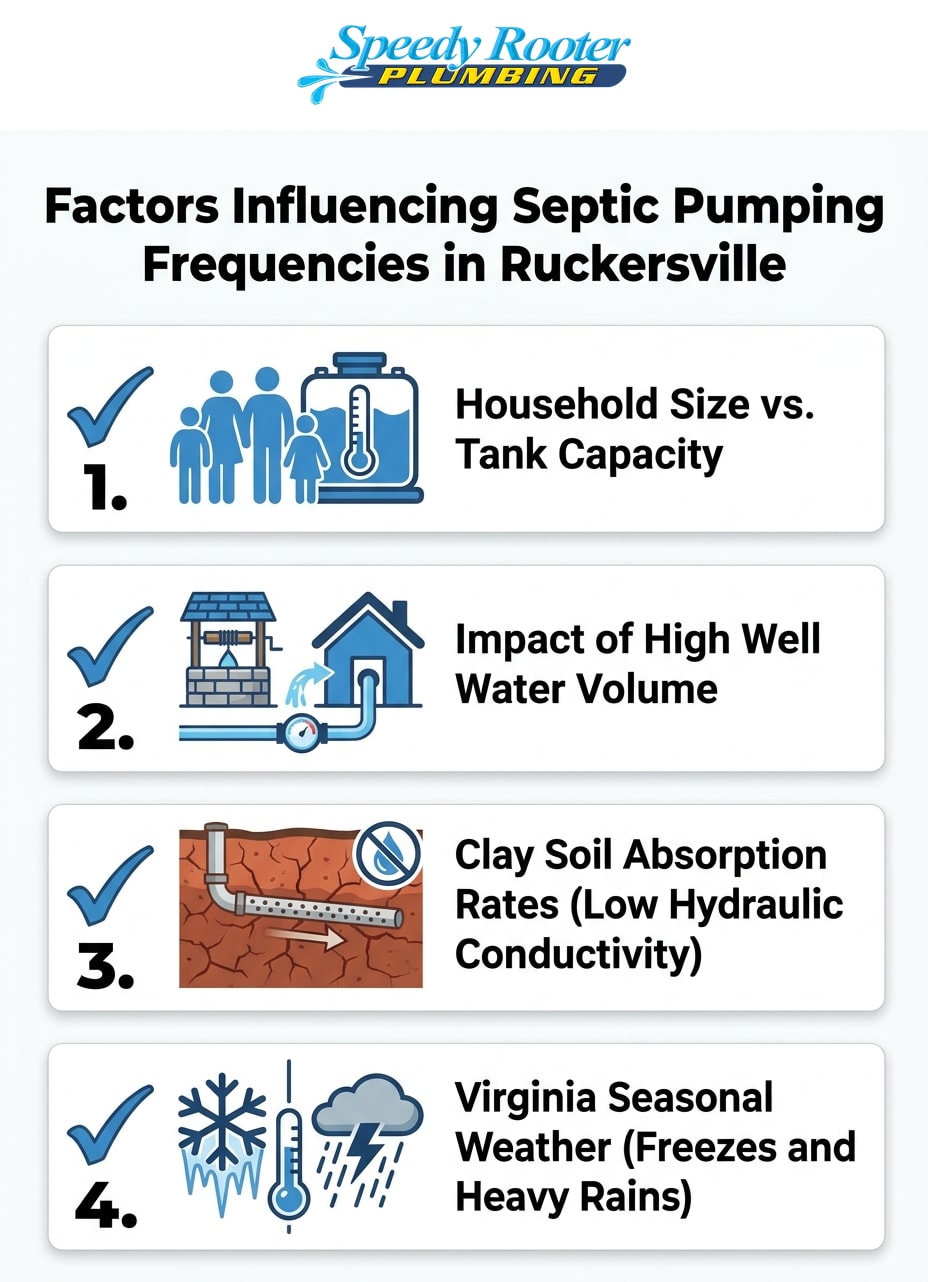
Key Factors Dictating Septic Tank Pumping Frequencies for Ruckersville, VA Rural Properties
Determining exactly when to service your system requires looking at the unique variables of your home. Rather than relying on a generic national chart, our specialists consider how the following factors interact on Greene County / Ruckersville rural properties:
- Household Size: The math here is simple. More occupants mean more showers, more laundry, and more wastewater generated daily. A family of six generating 400+ gallons daily will fill a tank significantly faster than a couple living in the same sized house.
- Tank Capacity: Smaller tanks require significantly more frequent emptying. If you have an older home with a legacy 500-gallon tank, your maintenance schedule will be much tighter than a modern build with a 1,500-gallon capacity.
- Well Water Volume: As discussed, high daily water usage from unmetered wells prevents proper solid separation. Excessive flushing pushes solids out into the field lines before they can settle.
- Soil Absorption Rates: Local clay soil drastically reduces the speed at which the drain field empties. This slow absorption acts as a bottleneck, keeping the tank artificially full.
- Seasonal Weather Limits: Freezing temperatures and heavy rainfall temporarily halt absorption entirely. This is exactly why your septic system needs pumping before the ground freezes, ensuring you have maximum holding capacity when the soil cannot do its job.
By evaluating these five factors together, a Speedy Rooter Plumbing professional can calculate a highly accurate, customized maintenance timeline that keeps your property safe year-round.
Recognizing When Your System Needs Immediate Attention
Even with a carefully calculated maintenance schedule, unexpected issues can arise. It is crucial to monitor your property for sensory warning signs that indicate your system is struggling to keep up with household demand. When residents call us with local septic queries regarding well water usage, we often hear homeowners asking how to tell if their high water volume has finally overwhelmed the tank.
Our plumbers know that the most obvious red flag is foul odors. If you notice a distinct sewage smell lingering near the tank lid or out over the drain field, your system is likely at maximum capacity. Inside the house, you might notice slow draining fixtures in your sinks and showers, or hear strange gurgling sounds coming from the toilet when you run the washing machine. These are clear indicators that the wastewater is struggling to push past a blockage or a full tank.
Visual Changes in Your Yard
Another critical symptom happens right on your lawn. Pay attention to the appearance of unusually lush, green grass directly over the drain field, especially during dry seasons when the rest of the yard is brown. While it might look nice, this hyper-growth means nutrient-rich wastewater is pooling just below the surface instead of draining downward.
| Warning Sign | What It Typically Means |
|---|---|
| Foul Odors Outdoors | Tank is overfull or effluent is pooling on the surface. |
| Gurgling Indoor Pipes | Air is trapped because wastewater is backing up the line. |
| Lush, Spongy Grass | Drain field is failing to absorb liquid deep into the soil. |
| Slow Drains | A potential clog in the main sewer line or a full tank. |
We must emphasize that these symptoms require immediate assessment by a licensed professional. Opening a septic tank or attempting to snake a main line yourself exposes you to hazardous gases and biohazards. Never attempt DIY diagnostic work on these systems. If you notice any of these warning signs of drain field issues, call an expert to evaluate the situation safely.
Frequently Asked Questions About Local Septic Maintenance
Navigating the specifics of wastewater management can be confusing, especially when local septic queries regarding well water usage and soil types yield conflicting advice online. Here are expert answers from the Speedy Rooter Plumbing team to the most common questions we hear from rural Virginia homeowners.
How does clay soil affect septic systems?
Clay soil dramatically slows down the rate at which a septic system can process wastewater. Because clay particles are microscopic and tightly packed together, they have very low hydraulic conductivity. This means liquid effluent takes much longer to absorb into the ground compared to sandy soils. As a result, the drain field acts as a bottleneck, causing the septic tank to stay fuller for longer periods.
How often should I pump my septic tank in Virginia?
While the standard national recommendation is every three to five years, rural Virginia properties often require more frequent service. Homes built on heavy Davidson clay, particularly those utilizing unmetered well water, often need pumping every two to three years. Your exact schedule should be customized by a professional based on your tank size, household water usage, and the specific soil composition of your yard.
Does well water usage affect my septic drain field?
Yes, unmetered well water can significantly impact the health of your drain field. Because well water does not come with a monthly usage bill, households pushing 300+ gallons daily tend to overload the system’s capacity. This excessive flushing creates turbulence that prevents solid waste from settling. When solids are pushed out into the drain field, it causes severe clogs and system failure.
What happens if you wait too long to pump your septic tank?
Waiting too long to pump allows the solid waste (sludge) at the bottom of the tank to build up too high. When the sludge level gets too close to the outlet pipe, those solid particles escape into the drain field lines. Once solids enter the drain field, they clog the perforated pipes and the surrounding soil, leading to catastrophic system failure, sewage backups into the home, and serious environmental hazards.
Can heavy rains cause my septic system to back up?
Yes, heavy seasonal rains are a common cause of temporary septic backups. When the ground soil becomes completely saturated by heavy rainfall, the drain field literally cannot accept any more liquid effluent. With nowhere for the wastewater to go, it backs up into the tank and eventually into the lowest drains in your home. Pumping your tank before the rainy season can provide a crucial buffer against these weather-related backups.
Establish a Customized Maintenance Schedule for Your Rural Property
As we have explored in our years serving this community, relying on generic, nationwide pumping schedules simply does not protect rural homes built on Greene County / Ruckersville rural properties. The heavy local clay soil acts as a natural barrier to rapid drainage, and when combined with the high volume of unmetered well water typical of country living, standard timelines fall short. Balancing your household water usage with local soil realities is the absolute key to maximizing the longevity of your wastewater infrastructure.
Taking action to protect your home involves three simple steps:
- Assess your baseline: Have a Speedy Rooter professional measure your current sludge and scum levels.
- Evaluate your water usage: Factor in your well water habits and household size.
- Lock in a schedule: Set a recurring reminder based on the professional calculation, not a generic chart.
You do not have to guess when your tank is reaching capacity, and you certainly should not wait for a messy backup to find out. By consulting with a licensed professional, you can evaluate your tank size, family water habits, and soil type to determine your exact needs. We encourage all homeowners to schedule a professional inspection to assess their current levels and establish a safe, reliable routine.
By understanding the unique Septic Tank Pumping Frequencies for Ruckersville, VA Rural Properties, you can gain peace of mind knowing your system is protected. Reach out to our local experts today to set up your customized maintenance plan and keep your property safe, clean, and functioning perfectly for years to come.
More From the Blog
-
How Line Locating Services Prevent Catastrophic Remodeling Mistakes
Starting a yard excavation or basement remodel without mapping utilities carries massive hidden risks. See why professional line locating is a critical first step before any shovel hits the dirt.
-
Thanksgiving Drain Backups: The Anatomy of a Kitchen Sink Failure
Preparing for the Predictable Thanksgiving Plumbing Surge Thanksgiving morning brings a flurry of activity, with multiple dishes cooking, guests arriving, and the…
-
Decoding Low Water Pressure: When the Problem is Your Main Line
Diagnosing a System-Wide Drop in Water Pressure You turn on the shower to get ready for the day, but only a weak…











24/7 Emergency Service
Contact Us Today
Contact Us Today
When in need of basic and emergency plumbing services, call Speedy Rooter Plumbing. We are the team that you can trust for services from a reliable plumber in Charlottesville, VA, and nearby areas. We have a committed team of well-trained professionals waiting to address your needs. Call us today or fill out the form on this site to schedule your appointment.